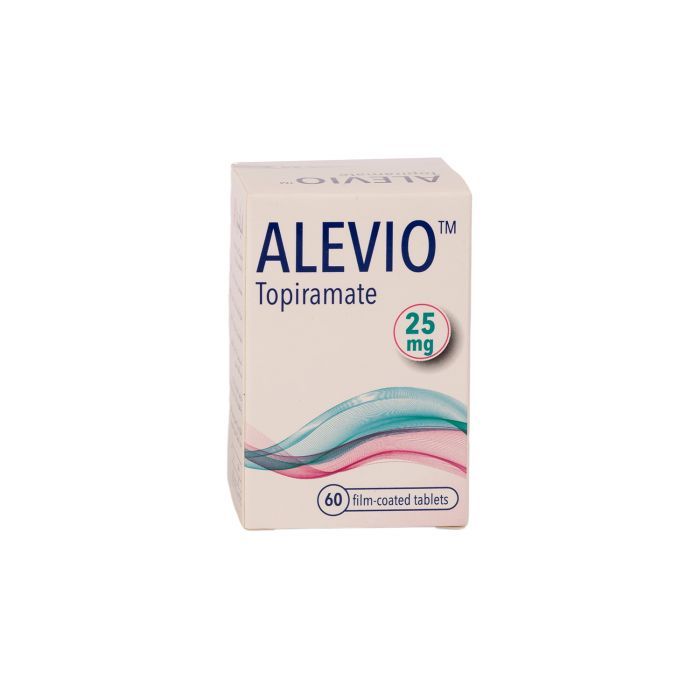
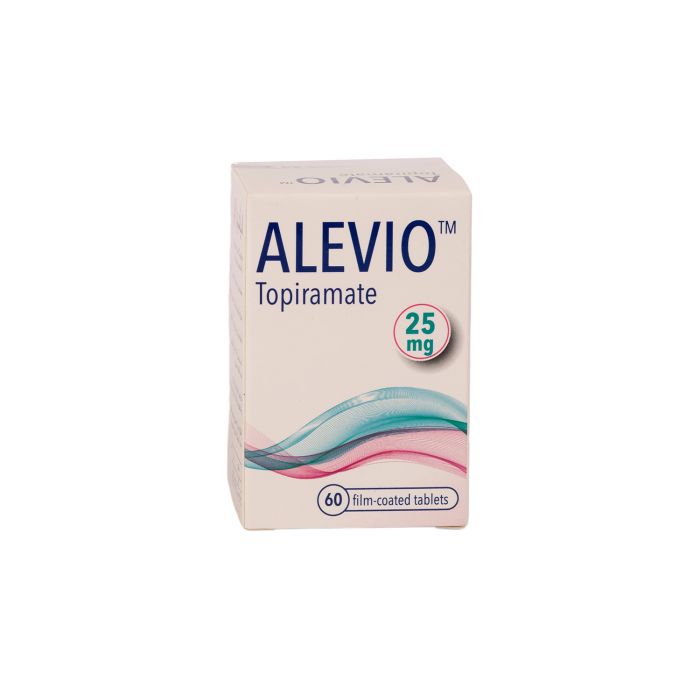
Alevio 25 mg is an oral prescription medication containing topiramate, a broad-spectrum antiepileptic agent belonging to the sulfamate-substituted monosaccharide class. It is formulated to manage neurological disorders characterized by abnormal neuronal hyperexcitability.
Active Ingredient: Topiramate (25 mg)
Therapeutic Category: Antiepileptic / Anti-Migraine Prophylactic
Dosage Form: Oral Film-Coated Tablets
Pack Size: 60 Tablets
Prescription Status: Prescription Only Medication (Rx)
Clinical Indications
Active Ingredients & Pharmacological Mechanism
Composition
-
Active Substance: Topiramate — 25 mg per film-coated tablet.
-
Excipients: Formulated with standard pharmaceutical-grade binders, disintegrants, and coating agents ensuring optimal bioavailability and stability under regulated storage conditions.
Pharmacodynamic Mechanism of Action
Topiramate stabilizes neuronal membranes and modulates action potential discharge via four primary cellular mechanisms:
-
Voltage-Gated Sodium Channel Blockade: Inhibits sustained repetitive firing of action potentials by blocking voltage-dependent sodium channels in a state-dependent manner.
-
GABA Subtype Enhancement: Augments the activity of gamma-aminobutyric acid (GABA) at specific GABA-A receptor subtypes, enhancing inhibitory neurotransmission.
-
Glutamate Receptor Inhibition: Antagonizes the AMPA/kainate subtype of glutamate receptors, suppressing excitatory neurotransmission in neuronal pathways.
-
Carbonic Anhydrase Isoenzyme Inhibition: Weakly inhibits carbonic anhydrase (specifically isoenzymes CA-II and CA-IV), contributing to tissue metabolic changes and neuronal stabilization.
Key Clinical Benefits & Therapeutic Value
| Feature |
Clinical Benefit |
Impact on Patient Outcome |
| Broad-Spectrum Efficacy |
Addresses multiple seizure phenotypes |
Reduces seizure frequency across generalized and partial-onset classifications. |
| Migraine Prevention |
Reduces central hyperexcitability |
Lowers monthly migraine frequency and severity when used as daily prophylaxis. |
| Flexible Titration |
Low baseline strength (25 mg) |
Allows step-wise dose titration to minimize central nervous system (CNS) adverse events. |
| Non-Narcotic Action |
Non-sedative mechanism of addiction |
Provides a non-habituating option for long-term neurological care. |
Usage Instructions & Dosage Administration
General Administration
-
Route: Oral administration.
-
Method: Swallow tablets whole with an adequate volume of water. Tablets should not be crushed, split, or chewed due to the bitter taste of topiramate.
-
Food Compatibility: May be taken with or without food. Dietary intake does not clinically alter systemic absorption.
Titration Guidelines
Topiramate therapy requires a gradual dose titration schedule supervised by a healthcare practitioner to achieve target therapeutic plasma levels while minimizing side effects.
-
Initial Phase: Typically initiated at a low dose (e.g., 25 mg nightly) for the first week.
-
Maintenance Phase: Escalated weekly by increments of 25 mg to 50 mg per day, divided into two daily doses, depending on clinical response and tolerability.
-
Discontinuation: Must never be stopped abruptly. Abrupt withdrawal in patients with epilepsy may precipitate status epilepticus. Gradual tapering under medical supervision is mandatory.
Safety Precautions, Warnings & Side Effects
Contraindications
Essential Warnings & Precautions
-
Oligohidrosis and Hyperthermia: Reduced sweating and elevated body temperature can occur, primarily in pediatric patients. Adequate hydration and protection from extreme environmental heat are necessary.
-
Metabolic Acidosis: Topiramate can cause hyperchloremic, non-anion gap metabolic acidosis due to its carbonic anhydrase inhibition. Serum bicarbonate should be monitored periodically baseline and during therapy.
-
Acute Myopia and Secondary Angle-Closure Glaucoma: Symptoms include acute onset of decreased visual acuity and/or ocular pain. Symptoms typically occur within 1 month of initiation. Immediate discontinuation and ophthalmological consultation are required.
-
Cognitive/Neuropsychiatric Adverse Reactions: May cause central nervous system reactions, including psychomotor slowing, difficulty with concentration, language problems, and somnolence.
-
Renal Calculi (Kidney Stones): Risk is increased due to carbonic anhydrase inhibition. Maintain fluid intake to lower risk.
Pregnancy & Lactation Warnings
-
Pregnancy Category: Topiramate can cause fetal harm, including an increased risk of oral clefts (cleft lip/palate) and being small for gestational age (SGA) when administered to a pregnant woman. It should only be prescribed during pregnancy if the potential benefit outweighs the potential risk.
-
Contraception: Topiramate may decrease the efficacy of estrogen-containing oral contraceptives at daily doses exceeding 200 mg.
Common Potential Side Effects
-
Vascular/Neurological: Paresthesia (tingling sensation in extremities), fatigue, dizziness, somnolence.
-
Metabolic/Gastrointestinal: Nausea, anorexia, weight loss, dysgeusia (taste perversion).
-
Cognitive: Slowed cognitive processing, memory impairment.
Storage & Handling
-
Temperature: Store below 25°C in a dry environment.
-
Packaging: Keep tablets in the original container or blister packaging to protect from moisture and light.
-
Safety: Keep out of reach and sight of children.





 Medication